Roll up to twelve dice. Every face has the same chance, drawn by your browser’s crypto generator.
Which dice you can roll
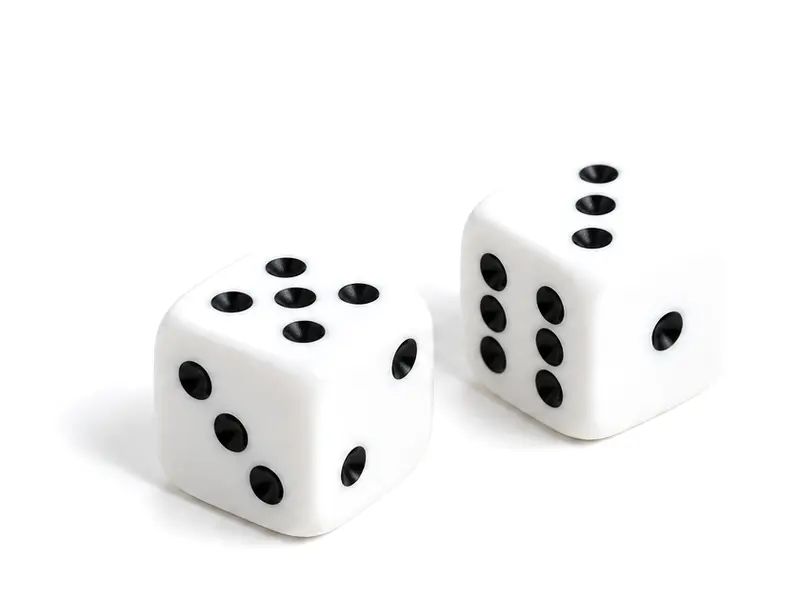
The seven dice of a standard tabletop set: d4, d6, d8, d10, d12, d20 and d100. Pick the die, set how many, from one to twelve, and roll. Under the dice you get the total, each face in order, and the lowest and highest of the roll.
Every die counts from 1 to its number of sides. The d6 shows pips; the others show the number.
What to expect from two six-sided dice
Board games built on two d6 lean on the fact that the totals are not equally likely. Out of 36 possible pairs:
| Total | Pairs that make it | Chance |
|---|---|---|
| 2 or 12 | 1 each | 2.8% each |
| 3 or 11 | 2 each | 5.6% each |
| 4 or 10 | 3 each | 8.3% each |
| 5 or 9 | 4 each | 11.1% each |
| 6 or 8 | 5 each | 13.9% each |
| 7 | 6 | 16.7% |
How each roll is drawn
Each die is its own draw from the browser’s cryptographic generator. A raw random number is rarely a multiple of the number of sides, and simply taking the remainder would make the low faces a little more likely. The roller discards the numbers that fall in the uneven tail and draws again, so on a d20 each face comes up exactly one time in twenty.
For a range that is not on a die, use the random number generator. For a two-way call, flip a coin.